
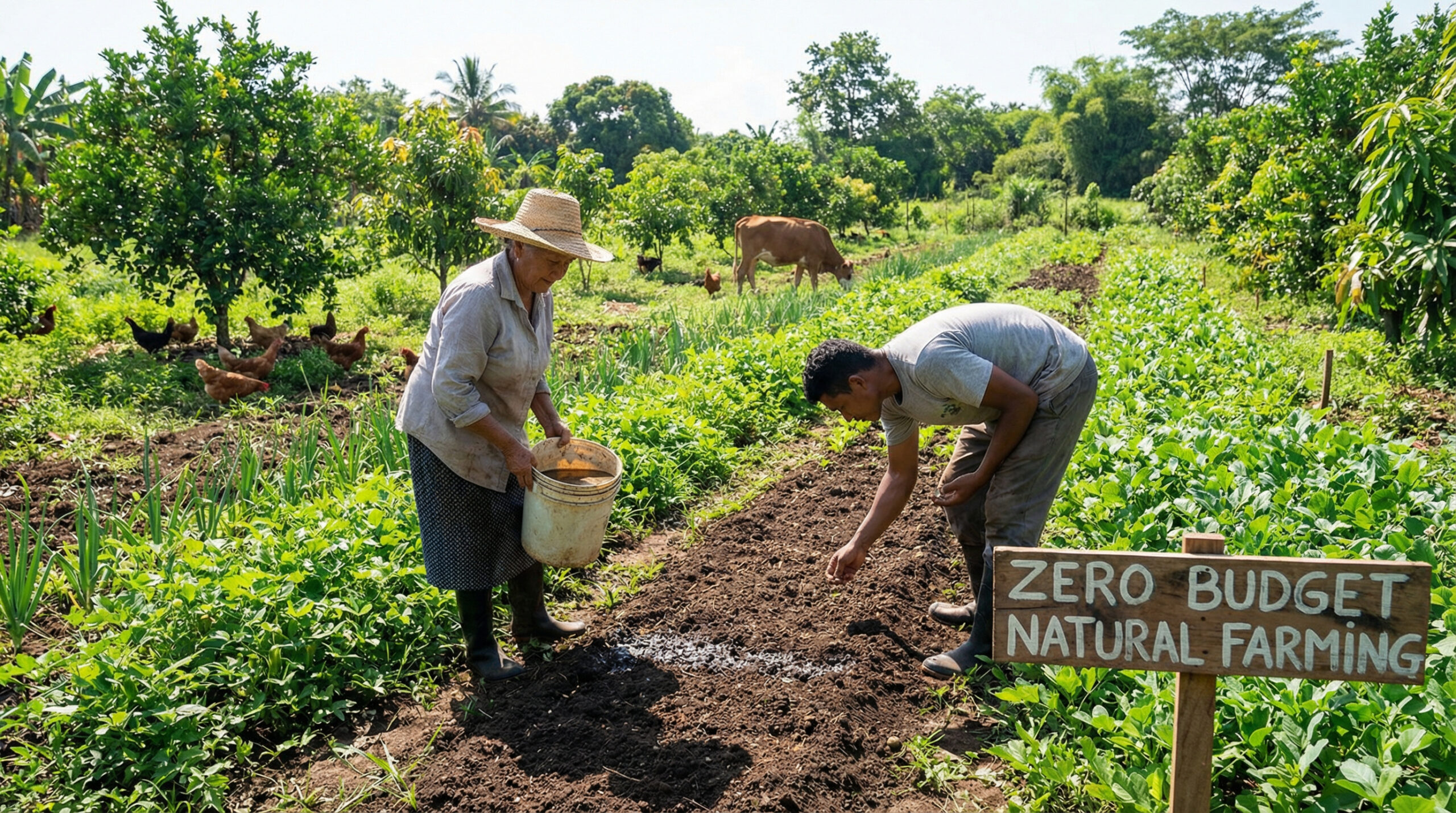
Zero Budget Natural Farming Guide for Modern Sustainable Agriculture
Imagine a farm where the soil breathes, the water stays trapped in the earth even during a heatwave, and the “fertilizer bill” at the end of the month is exactly zero. It sounds like a dream from a bygone era, doesn’t it? But for millions of farmers globally, this isn’t a dream, it is a daily reality.
For decades, we have been told that to feed the world, we must dominate nature with lab-grown chemicals and expensive machinery. This “Green Revolution” approach did increase yields initially, but it came with a hidden price tag: depleted soil, poisoned groundwater, and a crushing debt cycle for farmers. Today, we are standing at a crossroads. Zero Budget Natural Farming (ZBNF) offers a way back, not by retreating into the past, but by using a sophisticated understanding of microbiology to work with nature rather than against it.
In this guide, we will explore how you can restore your land’s health, eliminate external input costs, and build a farm that is truly resilient in the face of a changing climate.
What is Zero Budget Natural Farming?
At its simplest, Zero Budget Natural Farming is a method of chemical-free agriculture that draws on traditional Indian practices and modern biological science. The “Zero Budget” part refers to the fact that you do not need to buy fertilizers, pesticides, or expensive seeds from the market. Instead, everything the plant needs to grow is processed naturally on the farm itself.
The philosophy is rooted in the belief that the soil already contains all the nutrients required for plant growth. However, these nutrients are often “locked” in a form that plants cannot absorb. ZBNF uses biological catalysts made primarily from the dung and urine of indigenous cows to “unlock” these nutrients by multiplying beneficial soil microbes. It is a transition from input-intensive farming to process-intensive farming.
Why choose Zero Budget Natural Farming now?
The timing for this shift has never been more critical. According to the Food and Agriculture Organization (FAO), nearly one-third of the world’s soil is already moderately to highly degraded. In traditional chemical farming, as the soil loses its natural fertility, farmers are forced to apply even more fertilizer to maintain the same yield. This creates a “vicious cycle” of increasing costs and decreasing soil health.
By choosing Zero Budget Natural Farming, you are essentially “firing” the chemical companies and “hiring” the microbes. This method reduces your financial risk, making your farm profitable even in years when market prices for crops fluctuate. Furthermore, natural farming produces nutrient-dense food that is free from toxic residues, catering to a rapidly growing global market of health-conscious consumers.
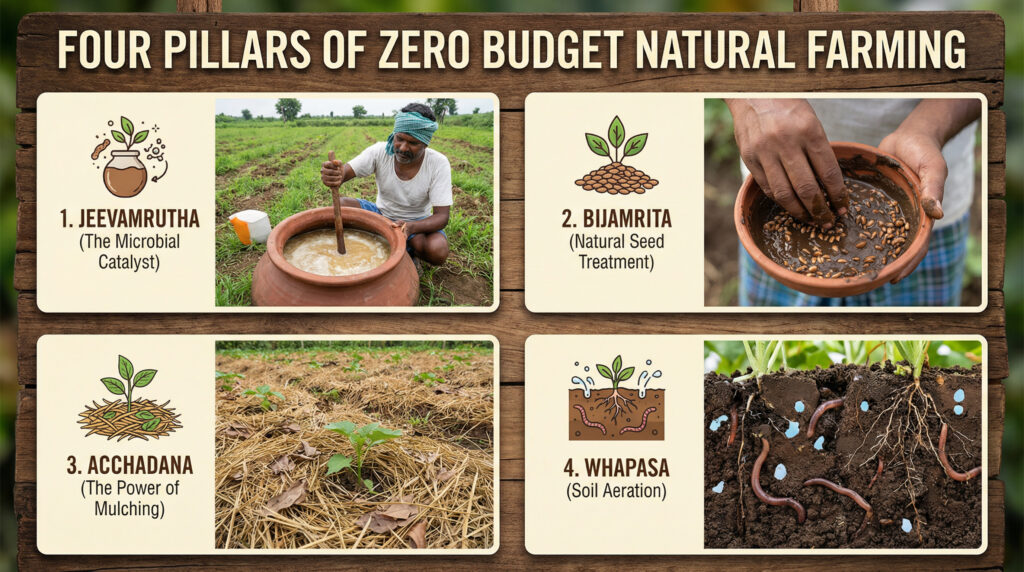
What are the four pillars of Zero Budget Natural Farming?
To succeed in this method, you must master the four pillars that sustain the ecosystem. These aren’t just “techniques”; they are the biological engines of your farm.
Jeevamrutha (The Microbial Catalyst)
The first pillar is Jeevamrutha, which serves as a potent microbial catalyst. Unlike chemical fertilizers that attempt to feed the plant directly, Jeevamrutha acts by providing the “cooks” – the essential microbes, who prepare and unlock the nutrients already dormant in your soil. To create this, a mixture of cow dung, urine, jaggery, pulse flour, and a handful of virgin soil is fermented for roughly 48 to 72 hours. The result is a single application that introduces billions of beneficial bacteria and fungi, rapidly accelerating the decomposition of organic matter and revitalizing the soil’s living web.
Bijamrita (Natural Seed Treatment)
Success in Zero Budget Natural Farming actually begins before the seed even touches the earth through the second pillar, Bijamrita. This natural seed treatment involves coating seeds or seedlings to shield them from both seed-borne and soil-borne diseases. By serving as a biological alternative to toxic chemical fungicides, Bijamrita ensures a significantly higher germination rate and provides the young plant with strong early-stage immunity.
Acchadana (The Power of Mulching)
The third pillar, Acchadana, focuses on the principle that nature never leaves its soil naked. This practice of mulching covers the soil surface with organic residues or live crops to maintain health. Soil mulch protects the delicate topsoil from erosion during cultivation, while straw mulch utilizes dried biomass to suppress weeds and retain vital moisture. Furthermore, live mulching, the practice of planting diverse crops like legumes simultaneously covers the ground and fixes nitrogen into the earth.
Whapasa (Soil Aeration)
Finally, the fourth pillar is Whapasa, which addresses soil aeration. There is a common misconception that plants require massive amounts of liquid water; in reality, they thrive on a balance of water vapor and air within the soil pores. By improving soil structure through sustained microbial activity and consistent mulching, this method reduces irrigation needs by up to 90%. The soil effectively becomes a sponge, holding moisture in a gaseous state that is perfectly accessible to the roots.
How does Zero Budget Natural Farming improve soil?
The transition to ZBNF is essentially a rescue mission for your soil’s “Food Web.” When you stop using chemical pesticides and fertilizers, the earthworms, nature’s best engineers return to the surface. As they move through the earth, they create deep burrows that allow air and water to penetrate deep into the root zone.
Moreover, Zero Budget Natural Farming is a powerful tool for Carbon Sequestration. By keeping the soil covered and increasing organic matter, the farm pulls carbon dioxide out of the atmosphere and stores it in the ground. Over time, the soil becomes darker, spongier, and more resilient to droughts. Studies from various field trials suggest that organic carbon levels in ZBNF farms can significantly increase within just three to five years of consistent practice.
Is Zero Budget Natural Farming actually profitable?
When evaluating the financial viability of agriculture, the true metric of success isn’t the total harvest volume, but the net profit remaining in your pocket. Conventional farming often falls into a “debt trap” where high yields are offset by the soaring costs of synthetic fertilizers, pesticides, and hybrid seeds. In contrast, Zero Budget Natural Farming shifts the focus toward economic independence.
- Input Cost Elimination: By utilizing on-farm biological resources, your external expenditure drops to nearly zero, shielding you from fluctuating market prices for chemicals.
- Climate Resilience: ZBNF crops develop deeper root systems, acting as a natural insurance policy against droughts and storms that often devastate “pampered” chemical crops.
- Market Premium: As global demand for toxin-free food rises, your produce earns higher value through direct-to-consumer trust and natural certifications.
- Land Appreciation: You are transforming your primary asset from a depleted liability into a fertile, living legacy.
Ultimately, this transition ensures that your farm is not just a place of labor, but a self-sustaining financial engine that secures long-term wealth.
How to start your natural farming transition?
Transitioning to Zero Budget Natural Farming is a marathon, not a sprint. To ensure long-term success without risking your entire livelihood, follow this strategic roadmap:
- Implement a Test Patch: Avoid the temptation to convert your entire 50-acre farm overnight. Instead, dedicate 10% of your land to ZBNF for one full season. This allows you to learn the rhythm of natural cycles without financial pressure.
- Source Indigenous Livestock: The “Zero Budget” engine runs on the dung and urine of indigenous (Desi) cow breeds. Research indicates that their microbial count is significantly higher than that of exotic breeds, which is vital for activating soil biology.
- Prioritize Soil Observation: Become an active observer. Success isn’t just measured in height, but in the return of earthworms and the soil’s newfound ability to retain moisture during dry spells.
- Integrate Crop Diversity: Break the monoculture habit. Intercropping with beans, marigolds, or mustard manages pests naturally while replenishing the nutrient profile of your land.
By starting small and focusing on biological health, you build a resilient foundation that makes a full-scale transition both predictable and profitable.
Overall…
Zero Budget Natural Farming is more than an agricultural technique; it is a movement toward freedom. It frees the farmer from debt, frees the consumer from toxins, and frees the earth from degradation. By understanding and implementing the four pillars, you aren’t just growing food; you are healing a piece of the planet.
The journey toward sustainable agriculture requires patience and a shift in mindset, but the rewards – a profitable, healthy, and resilient farm are well worth the effort.
The journey toward sustainable agriculture requires patience, a shift in mindset, and a commitment to long-term health over short-term chemical fixes. However, the rewards of a profitable, healthy, and resilient farm that can withstand the challenges of a changing climate are well worth every effort. As we look toward a future where food security and environmental stewardship go hand in hand, Invade Agro Global is leading the way by providing the expertise and support needed to make this sustainable vision a reality for farmers everywhere.