The Role of Soil Health Management in Long-Term Plantation Productivity
Take a stroll down a plantation, perhaps tea on hill mists, coffee under sprawling covers, or rubber under infinite fields, and you would see something consistent in the backdrop of all these: the soil. Perhaps leaves, fruits, and harvests are in sight, but it is the soil that quietly works to give life. Soil is like a long-term business partner in so many aspects. When it is taken care of, it provides support for growth over decades; when neglected, it cuts off support at any given time.
For plantations to be expanded through generations, this reality accumulates all the more. You can transplant your crops, but it is difficult to recover infected soil, which could take years. It is here that the importance of soil health and efficient soil health management come into the picture not as a luxury, but as a requirement for long-term success.
What Do We Mean by Soil Health in Plantations?
Soil health is more than nutrient availability. Soil health is the overall ability of the soil to be a living, dynamic medium that supports plants, ecosystems, and people.
There are three characteristics of healthy soil:
- Physical: pore space, porosity, water-holding capacity.
- Chemical: optimal pH balance, available nutrients, organic matter.
- Biological: microbial activity, earthworms, fungi, other organisms.
When these elements are collated, soil is an independent anchor. The general outlook is that soil health management anchors and possesses the importance of soil health to long-term success.
Why Is the Importance of Soil Health So Crucial for Plantation Productivity?
Plantations are long-term investments taking decades, a half-century in other cases. For decades-long plans, soils must be productive and resilient.
As per the FAO report, revitalizing the fertility of degraded lands can increase farm production by up to 58%. This is not just a static, it is what adds up to livelihood and harvest for plantation farmers.
Poor soil health weakens crops, increases the risk of diseases, and reduces the farm profitability. Whereas, the healthy soils facilitate the growth of roots, control water and provide a slow and steady nutrient supply.
What are the Threats facing Soil Health in Plantations Nowadays?
Plantations are also under extra stress because they occupy the same soils every year. These extra stresses pile up over the years to pose huge risks.
Overuse of Chemicals
As a short-term solution, most of the farmers rely on fertilizers and pesticides but their misuse leads to nutrient imbalances and lowered diversity in soils. Microbial communities, the soil’s hidden workers; disappear under chemical attack, reducing inherent fertility.
Monoculture Practices
Tea, rubber, or coffee is usually cultivated every single day of the year without rotation. This starves the soil of specific nutrients while contributing to pests and diseases. Monocropping depleted the soil in the long run.
Soil Erosion and Compaction
Plantation soils, particularly on slopes, easily get washed away during heavy rainfall. In the meantime, regular traffic compacts the soil, which reduces porosity and destabilizes plant roots.
Climate Change Pressures
Unpredictable floods, droughts, and salinity fluctuation are stress multipliers. The United Nations Office for Disaster Risk Reduction (UNDRR) warns that nearly 33% of global soils are moderately to highly degraded. Low resilience and high vulnerability are the outcomes of plantations.
All of these are the reasons why active soil health management is no longer a choice but is a requirement.
How Can Soil Health Management Enhance Plantation Productivity?
The comforting fact is that soil, if managed well, has the ability to heal and amply reward farmers. Effective soil management involves a series of supporting measures.
Organic Matter Management
Composting, green manure, or buried crop residues put organic carbon into soil. Supplemental nutrient cycling isn’t just achieved, but so too is stored water. Legumes, for instance, contribute nitrogen and enrich the soil naturally by growing cover crops.
Soil Conservation Methods
Practices like mulching, slope planting, and terracing save water and also prevent erosion. Terracing, in sloping tea estates, has minimized soil runoff to a great extent, saving precious topsoil.
Balanced Fertilization
Integrated Nutrient Management (INM) optimizes organic inputs with balanced inorganic fertilizers. It avoids imbalances and allows long-term soil fertility to be maintained. For instance, coffee plantations that use INM have improved yields as well as lower input costs.
Water Management
Water is the life of the soil. Drip irrigation conserves water and delivers it directly to the roots with less salinity risk. Percolation ponds and rain harvesting are recharging the groundwater, and well-planned drainage facilities are protecting the plantation from waterlogging.
Agroforestry and Biodiversity
Shade trees in coffee plantations or rubber with legume form a highly structured system. They conserve nutrients, avoid soil erosion, and improve microclimates.
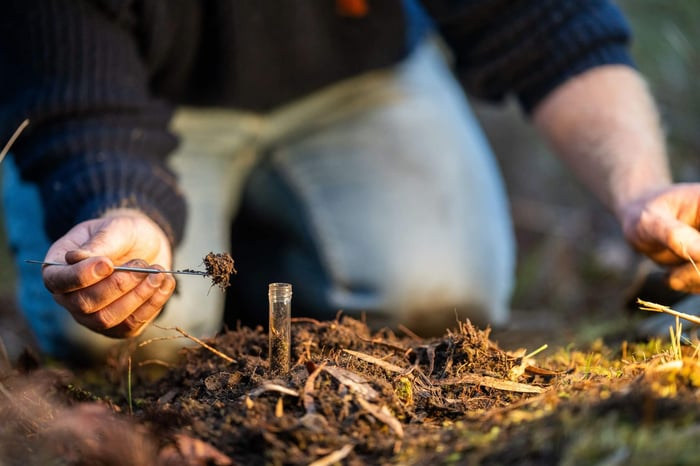
Soil Testing and Monitoring
As regular health check-ups tell about the health of a person, soil tests provide more effective interventions. Chemical analysis of pH, organic material, and nutrients allows farmers to balance their practice of soil health management in an effective way. You can read more in our detailed blog on the importance of soil testing for crop nutrition and soil health.
All these collective measures not only revive the health of plantations but also give them decades of output.
What are the Long-Term Benefits of Healthy Soil in Plantations?
The investment payback period for soil is long and varied.
- Consistent Yields and Quality: Healthy soils, of course, ensure consistent yields. Coffee beans from healthy soils are of better quality, and fruit orchards yield sweeter fruit.
- Stability in the Economy: Recycling nutrients naturally, healthy soils limit dependency on costly external inputs. This increases profitability, especially during price volatility.
- Weather Resilience: Porous, fertile soils tend to hold water during dry periods and let it drain readily when wet. Such adaptability is vital in the present climate change.
- Environmental Value: Highly organic soils can store more carbon, and that carbon stored is of higher value to global climate mitigation.
Lastly, the importance of soil health is that it will not only protect the plantation’s present profitability but also its future sustainability as well.
Which Real-Life Instances Illustrate Soil Health Management?
Theory is only inspiring when supported by success at the grassroots level. Success stories provided by the Food and Agriculture Organization (FAO) are a stark indication of the extraordinary difference soil health management makes on plantations and stable harvests.
Australia (Queensland Sugarcane)
Queensland sugarcane growers dropped conventional tillage and used minimum tillage with mulching of the residues. It largely reduced the erosion of the soil, maintained the content of organic matter at a stable level, and enhanced the holding capacity of the soil. The long-term yield stabilized and input cost decreased, thereby proving that soil farming in a sustainable manner was also an economically viable concept.
India (Nilgiris Tea Plantations, Tamil Nadu)
Nilgiris farmers were the pioneers in contour planting, vegetative screens, and organic mulches to avoid heavy hilly slope soil erosion. They conserved topsoil, promoted infiltration, and maintained soil fertility. Not only did the plantations reduce erosion loss, but they also produced healthier and robust tea bushes, so that crops were in abundance.
China (Loess Plateau Apple Orchards)
Degrading Loess Plateau soils were where apple farmers used cover cropping and organic amendments. Such cropping restored water-holding capacity, rebuilt soil organic matter, and spurred erosion reduction in an otherwise degrading landscape. Apple orchards were being promoted as models for the ability to restore soil to fuel ecological as well as economic change.
These examples testify that soil health management is not a theory but a proven path to success.
What Is the Future of Soil Health in Plantation Systems?
The future of the plantation will be determined by how much it adopts innovation and tradition.
Technological Innovations
Soil sensors currently provide real-time measurement of moisture and nutrient content. Drones assess soil heterogeneity in huge plantations, and artificial intelligence algorithms predict fertility needs, minimizing wastage and sensing more precisely.
Policy and Global Programs
Goals like the FAO Global Soil Partnership and World Bank-funded soil health management programs are driving global action toward sustainable practices. Governments also offer incentives for soil regeneration and conservation agriculture.
Community and Farmer-Led Action
Cooperatives are becoming change agents. Through sharing facilities like composting plants, soil analysis labs, or rainwater harvesting systems, small-scale farmers are able to adopt practices otherwise beyond their reach.
The value of the soil’s health will be even greater in the future. Under the growing pressure of the climate, the plantations that take the investment in healthy soils today will thrive tomorrow, and they will be paragons of sustainable agriculture.
Why Soil Health Management Matters More Than Ever
Plantations are not short-term propositions; they are legacies. And land is the quiet partner that determines their fate. By responsible stewardship of the soil, farmers produce more, reduce their costs, and maintain strong systems that endure for generations.
Ignore the soil, and the plantation quietly dies before it’s too late. Care for it, and the land provides generously again and again. As the saying goes, “We do not inherit the earth from our ancestors; we borrow it from our children.”
We at Invade Agro Global still believe in promoting the development of practices that give greater emphasis to having good soil health in the face of a sustainable future. Learn more about it on our blog page about sustainable farming solutions.