Farm Data Analytics That Turns Information Into Actionable Farming Decisions
Farming today is no longer just about producing more. It is about producing smarter. Across regions and crop systems, farmers are navigating tighter margins, unpredictable weather patterns, and rising input costs, all while being expected to meet growing food demand. Traditional experience and intuition still matter, but on their own, they are no longer enough to carry the weight of modern farming decisions.
At the heart of this shift lies a simple reality: every decision now carries greater consequence than it did a decade ago. When water, nutrients, time, and capital are limited, the difference between a good season and a difficult one often comes down to decision accuracy. This is where farm data analytics begins to matter, not as a technology trend, but as a practical tool that helps farms move from reactive choices to informed, deliberate actions.
In today’s agricultural landscape, better decisions are not optional. They are the edge that determines resilience, efficiency, and long-term success.
Why Decision Accuracy Is Becoming the New Advantage in Agriculture
Globally, agriculture is being squeezed from both ends. On one side, food demand continues to rise as populations grow and diets evolve. On the other hand, critical resources such as water and soil health are under increasing stress. The Food and Agriculture Organization (FAO) has repeatedly highlighted that agricultural production must rise significantly by mid-century to meet future demand, but it must do so with far greater efficiency than in the past. At the same time, UNESCO reports that agriculture accounts for nearly 70 percent of global freshwater withdrawals, leaving very little room for error in how resources are used.
In this environment, traditional intuition-based farming is no longer enough. Every irrigation decision, input application, and timing choice carries higher risk and higher cost. Farms that can make accurate, data-backed decisions gain a clear advantage, not just in productivity, but in resilience and long-term viability. Today, decision accuracy is no longer a nice-to-have; it is what separates stable farms from struggling ones.
What farm data analytics really means on a working farm
In simple terms, farm data analytics is the ability to look at what is happening on your farm and connect it logically to outcomes.
Instead of asking, “What happened?” you begin asking, “Why did it happen, and what should I do differently next time?”
This could mean understanding why one plot consistently performs better than another, why a pest outbreak keeps returning despite repeated sprays, or why higher input costs are not translating into higher yields. The moment data starts answering these questions, it stops being passive information and becomes a decision tool.
This only works, however, when supported by strong agricultural data management. Without consistent records, standardized naming, and basic discipline in logging activities, analytics becomes unreliable. Good analytics always sits on top of good data habits.
Why many farms collect data but still struggle to decide
One of the most common mistakes farms make is assuming that collecting data automatically leads to better decisions. In reality, most farms face three silent issues.
First, data is fragmented. Irrigation records may sit in one notebook, fertilizer bills in another, and crop observations live only in someone’s memory. Without consolidation, patterns remain invisible.
Second, data is inconsistent. When plots are renamed every season or input quantities are recorded differently each time, comparisons become meaningless. This is where agricultural data management plays a foundational role.
Third, farms often fail to close the loop. Actions are recorded, but outcomes are not evaluated against them. Inputs are applied, but their impact on yield, quality, or cost is never truly measured.
Farm data analytics fixes this not by adding complexity, but by adding structure.
Where farm data analytics delivers the fastest impact
You do not need to analyze everything at once. In fact, the most successful farms focus analytics on a few high-impact decisions first.
Water management is usually the starting point. Irrigation decisions affect cost, crop health, and long-term soil condition. When irrigation events are tracked alongside rainfall, crop stage, and stress indicators, patterns quickly emerge. Farms that apply farm data analytics to irrigation often find they are watering too early, too late, or too uniformly across plots that behave very differently.
Input use is another critical area. Fertilizers and crop protection products represent a large share of variable costs. Analytics helps identify where inputs deliver returns and where they quietly erode margins. Research shows that precision and data-driven approaches can lead to measurable cost savings, particularly when farms use analytics consistently rather than sporadically.
Yield improvement becomes far more reliable when decisions are backed by evidence instead of assumptions. Many farms believe certain plots or varieties underperform, only to discover through analytics that timing or management practices are the real issue. Even basic yield comparisons, when done consistently, can change long-held beliefs.
Marketing decisions are often overlooked in data discussions, yet they matter deeply. Tracking net realization after deductions, transport costs, and payment delays allows farms to understand which buyers truly deliver value. Farm data analytics here transforms selling from habit into strategy.
A practical way to adopt farm data analytics without overwhelm
Adopting farm data analytics does not have to feel complex or intimidating. The process becomes manageable when it is approached with clear intent and simple steps.
Begin with one clear decision question
Start by identifying a single decision that directly affects outcomes on your farm, such as irrigation timing, input efficiency, or yield variation. Focusing on one question keeps farm data analytics practical, relevant, and easy to act upon.
Build a strong agricultural data management base
Before analysis, ensure discipline in agricultural data management. Use fixed plot names, standardized units, clear dates, and regular activity logging. This consistency matters more than advanced tools, as unreliable data leads to misleading insights.
Create a regular review rhythm
Shift away from end-of-season reviews. Weekly observations and monthly summaries keep insights fresh and usable. Farm data analytics delivers the most value when it guides decisions during the season, not after results are locked in.
Convert insights into simple decision rules
Turn learnings into clear operating rules that guide daily actions. Over time, these rules reduce emotional decisions and build confidence.
When farm data analytics is adopted step by step, it transforms uncertainty into clarity and decision-making into a calm, repeatable process.
Why mindset matters more than technology
Technology can certainly accelerate farm data analytics, but it can never replace discipline. A simple spreadsheet, when maintained consistently and reviewed regularly, often delivers more value than an advanced system used only occasionally. What truly drives better decisions is not the sophistication of the tool, but the seriousness with which data is recorded and used.
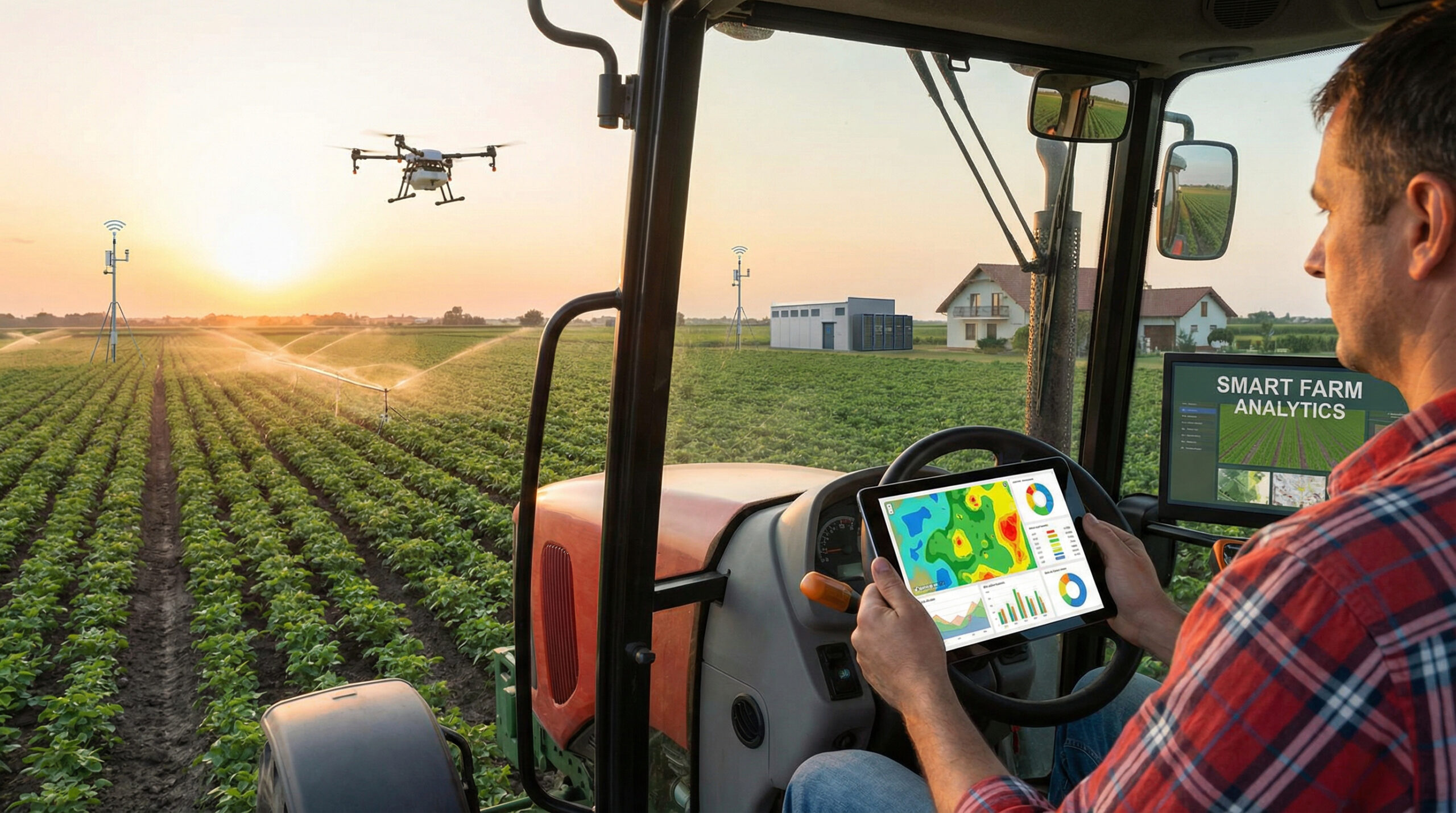
As farms grow in size and complexity, digital platforms begin to offer stronger returns. They bring structure, traceability, and visibility into daily operations. The most effective systems support plot-level tracking, mobile data entry, clear audit trails, and dashboards that answer real farming questions rather than generic metrics. These features reduce manual effort and help teams stay aligned.
Still, tools are only enablers. The core mindset never changes. Data exists to guide decisions, reduce uncertainty, and improve outcomes, not to look impressive or add complexity where none is needed.
The real outcome of farm data analytics
The true value of farm data analytics is not higher yields alone. It is confidence. Confidence that irrigation decisions are justified, that input spending is delivering real returns, and that when results fall short, there is a clear cause, and a clear path to fix it. This confidence changes how farms operate. Decisions become calmer and faster. Guesswork gives way to patterns, and panic is replaced by clarity. Over time, this shift builds farms that are not just more productive, but more resilient to changing weather, markets, and input costs.
If there is one takeaway, it is this: farm data analytics is not about becoming a tech-driven farm. It is about becoming a decision-driven farm. And in today’s agricultural reality, that difference can determine who merely survives and who steadily grows.
If you’re ready to move toward disciplined, decision-led farming, explore how Invade Agro Global is helping farms turn data into practical, profitable decisions across the agri value chain.