The Power of IoT Sensors for Agriculture in Mastering Soil and Weather Control
You don’t need me to tell you farming has become harder to predict. You feel it already – one unseasonal shower, one unexpected heat spike, one “normal” week that suddenly isn’t. And the frustrating part is this: most farm decisions still get made with partial information.
That’s exactly where IoT sensors come in.
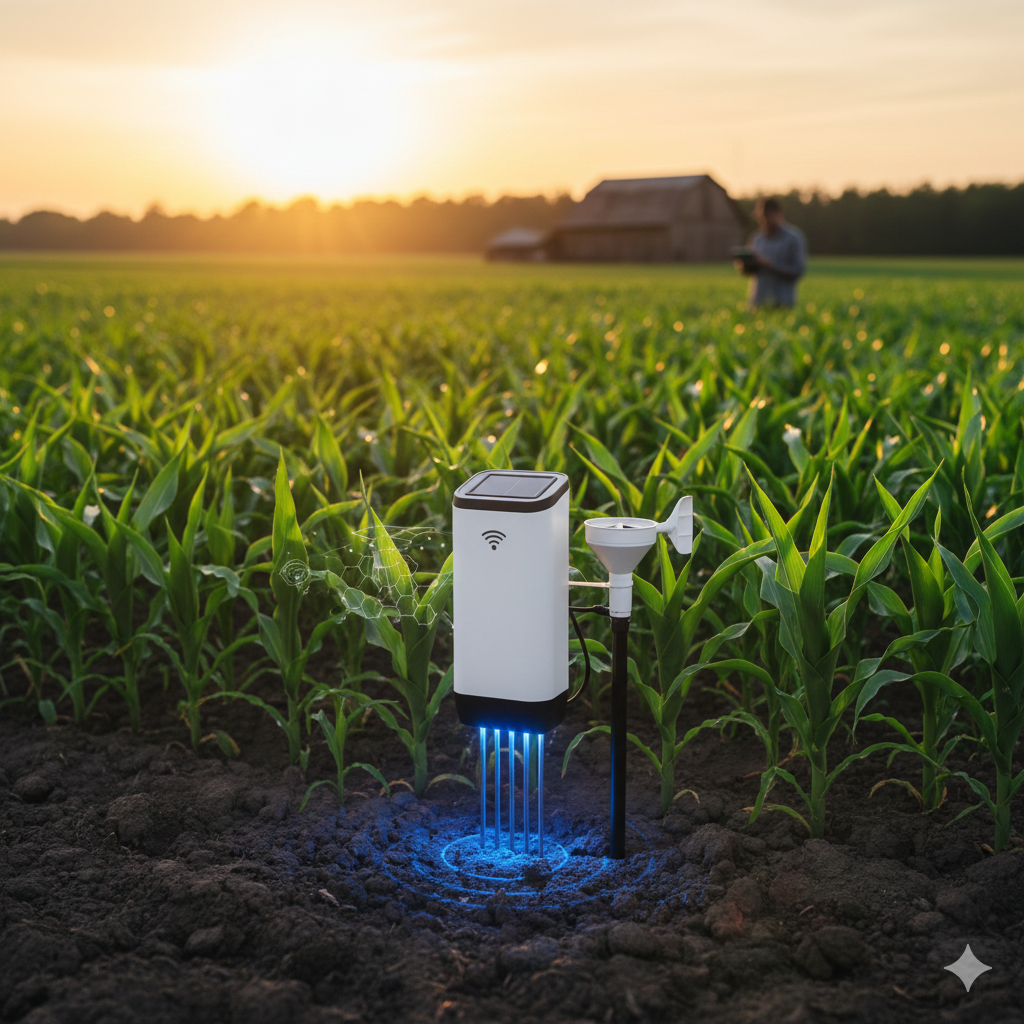
Think of them as your farm’s “nervous system” – quietly tracking what’s happening in the soil and the air, minute by minute, so you’re not forced to rely on gut feel alone. When you can see moisture levels, temperature swings, humidity patterns, and rainfall in real time, you stop reacting late and start acting early.
And this matters because agriculture isn’t just another water user, it’s the biggest one. Globally, agriculture accounts for about 70% of freshwater withdrawals, which means even small efficiency gains scale into a massive impact.
What are IoT sensors for agriculture?
IoT sensors for agriculture are connected devices placed in fields, orchards, or greenhouses to continuously measure conditions like:
- soil moisture at different depths
- soil temperature
- rainfall, wind, humidity, and air temperature
- leaf wetness (important for disease risk)
- sometimes even salinity and nutrient indicators (depending on system)
The “IoT” part simply means those sensors send data to an app or dashboard, often through cellular networks, LoRaWAN, or Wi-Fi, so you can check your farm conditions without walking every plot.
Here’s the real value: they turn invisible variables into visible signals. Once the data is visible, you can make decisions faster, more accurately, and with less waste.
Why use IoT sensors for agriculture today?
The short answer? Because the “old ways” are facing unprecedented pressure. We are operating in an era where water is becoming as valuable as oil, and soil health is declining globally. According to the FAO, nearly 33% of the world’s soil is already degraded. We simply cannot afford to mismanage the resources we have left.
IoT sensors for agriculture act as the bridge between the physical plant and the digital dashboard. These devices don’t just collect numbers; they provide a “voice” to the crop. In a world where a single heatwave or a week of over-irrigation can wipe out an entire season’s profit, these sensors provide the insurance policy every modern grower needs. They allow us to transition into “Climate-Smart” agriculture, where every drop of water and every gram of fertilizer is accounted for. By using these tools, you aren’t just farming harder; you are farming with a level of surgical precision that was physically impossible twenty years ago.
Why do traditional soil and weather methods fail today?
Traditional monitoring usually looks like this: a field visit, a quick soil feel test, a regional weather forecast, and then a decision.
That used to be “good enough.” But the gap has widened:
- Weather forecasts are regional, while farms operate on microclimates.
- One corner of your farm can hold moisture while another dries out.
- Rainfall might show up on an app but never actually hit your plot.
- By the time crop stress becomes visible, yield and quality damage often already started.
In short, manual monitoring is periodic, while farm risk is continuous.
This is also why microclimate measurement matters. Research highlights how station location and local landscape can strongly influence readings, which is another way of saying: your farm’s reality may not match a generic nearby weather station.
How do IoT sensors for agriculture monitor soil moisture?
Traditional monitoring usually looks like this: a field visit, a quick soil feel test, a regional weather forecast, and then a decision.
That used to be “good enough.” But the gap has widened:
- Weather forecasts are regional, while farms operate on microclimates.
- One corner of your farm can hold moisture while another dries out.
- Rainfall might show up on an app but never actually hit your plot.
- By the time crop stress becomes visible, yield and quality damage often already started.
In short, manual monitoring is periodic, while farm risk is continuous.
This is also why microclimate measurement matters. Research highlights how station location and local landscape can strongly influence readings, which is another way of saying: your farm’s reality may not match a generic nearby weather station.
How do IoT sensors for agriculture monitor soil moisture?
Let’s talk about the variable that quietly decides everything: soil moisture.
Soil moisture sensors measure how much water is available where roots actually function. And that changes the irrigation game in three powerful ways:
You stop irrigating “by calendar”
Instead of watering because it’s “day 7,” you water because the root zone actually needs it.
You reduce waste without reducing yield
This isn’t wishful thinking – multiple sources point to measurable water savings from soil moisture-based irrigation control. The U.S. EPA notes studies suggesting at least ~20% water savings from soil moisture sensors in irrigation contexts. A 2025 peer-reviewed review also reports ~15–20% reduction in water consumption when integrating sensors versus conventional methods in an irrigation setting.
You catch stress before the plant “shows” it
Plants don’t announce stress immediately. Moisture drops first. Sensors give you that early warning.
And yes, under the right conditions, the improvements can be dramatic. A University of Georgia report on container nurseries described reductions of up to 70% water use with sensor-based systems in that context.
How do IoT sensors for agriculture track weather at farm level?
Most farmers don’t need “more weather information.” They need the right weather information for their farm. On-farm weather sensors can track:
- rainfall (actual, not predicted)
- temperature highs and lows
- humidity trends that influence disease pressure
- wind speed and direction (spray planning)
This shifts decisions from reactive to proactive:
- You spray when conditions support coverage and reduce drift risk.
- You time irrigation around real rainfall, not forecasted rainfall.
- You monitor humidity and leaf wetness trends that often precede fungal outbreaks.
This is the quiet advantage: when you measure microclimate properly, you don’t just “know the weather.” You know your risk window.
How do IoT sensors improve smart farming and sustainable farming?
Let’s keep this practical. Sustainability is not a slogan on a banner. It’s a series of daily decisions that waste less and protect yield. IoT sensors improve smart farming by making three outcomes more achievable:
Higher water productivity
Because agriculture uses around 70% of global freshwater withdrawals, improving irrigation precision is one of the fastest ways to create real sustainability impact at scale.
Lower input loss
Overwatering can leach nutrients. Poorly timed sprays can get washed off. Sensors reduce those “blind moments” when money goes into the soil or air instead of the crop.
Better resilience under climate variability
The pattern is clear: climate change increases pressure on agriculture through higher temperatures, variable rainfall, and extreme events.
When variability rises, the value of real-time monitoring rises with it.
Where are IoT sensors for agriculture used on farms?
This is not “only for high-tech farms.” Sensors scale surprisingly well when you match them to your reality.
Open-field crops
Moisture sensors help with irrigation timing and water-use efficiency. Weather sensors help with spray decisions and heat stress monitoring.
Orchards and horticulture
Orchards often have microclimates created by canopy, spacing, and soil variation. Sensors help you avoid uneven irrigation and quality issues.
Greenhouses and protected cultivation
This is where sensors can deliver outsized value because conditions shift fast and control systems can respond quickly. The nursery example showing large water reductions is one illustration of how controlled environments can benefit from sensor-guided decisions.
What challenges should farmers consider before adoption?
IoT sensors are powerful, but they’re not magic. Here’s what a smart buyer thinks about upfront:
Connectivity and network coverage
Farms in remote areas may face poor internet access. Choosing sensors that work on low-power networks or store data offline is crucial.
Data interpretation and decision-making
Sensors provide information, but agronomic knowledge is still needed to act on that data correctly. Technology supports decisions, it does not replace experience.
Cost and return on investment
While prices have reduced, returns should be evaluated over one or more seasons rather than expecting immediate financial gains.
Integration with existing practices
Sensors deliver the best results when aligned with current irrigation systems, crop schedules, and advisory methods.
Training and maintenance
Basic training, regular calibration, and consistent data review are essential to ensure sensors continue delivering accurate and useful insights.
Addressing these challenges early helps farmers adopt IoT sensors smoothly and gain long-term value from the technology.
What does the future hold for IoT sensors in agriculture?
The next phase is not “more sensors everywhere.” It’s better integration:
- sensor data feeding into AI-driven recommendations
- predictive alerts instead of raw charts
- automated responses (like irrigation control) tied to real thresholds
The most exciting part is this: as data accumulates, farms move from “best guesses” to “repeatable decisions.” That’s how modern farming becomes less fragile.
At Invade Agro Global, we help farmers interpret these insights on the ground—through advisory support, access to the right inputs, and a strong farming community that turns information into practical action.