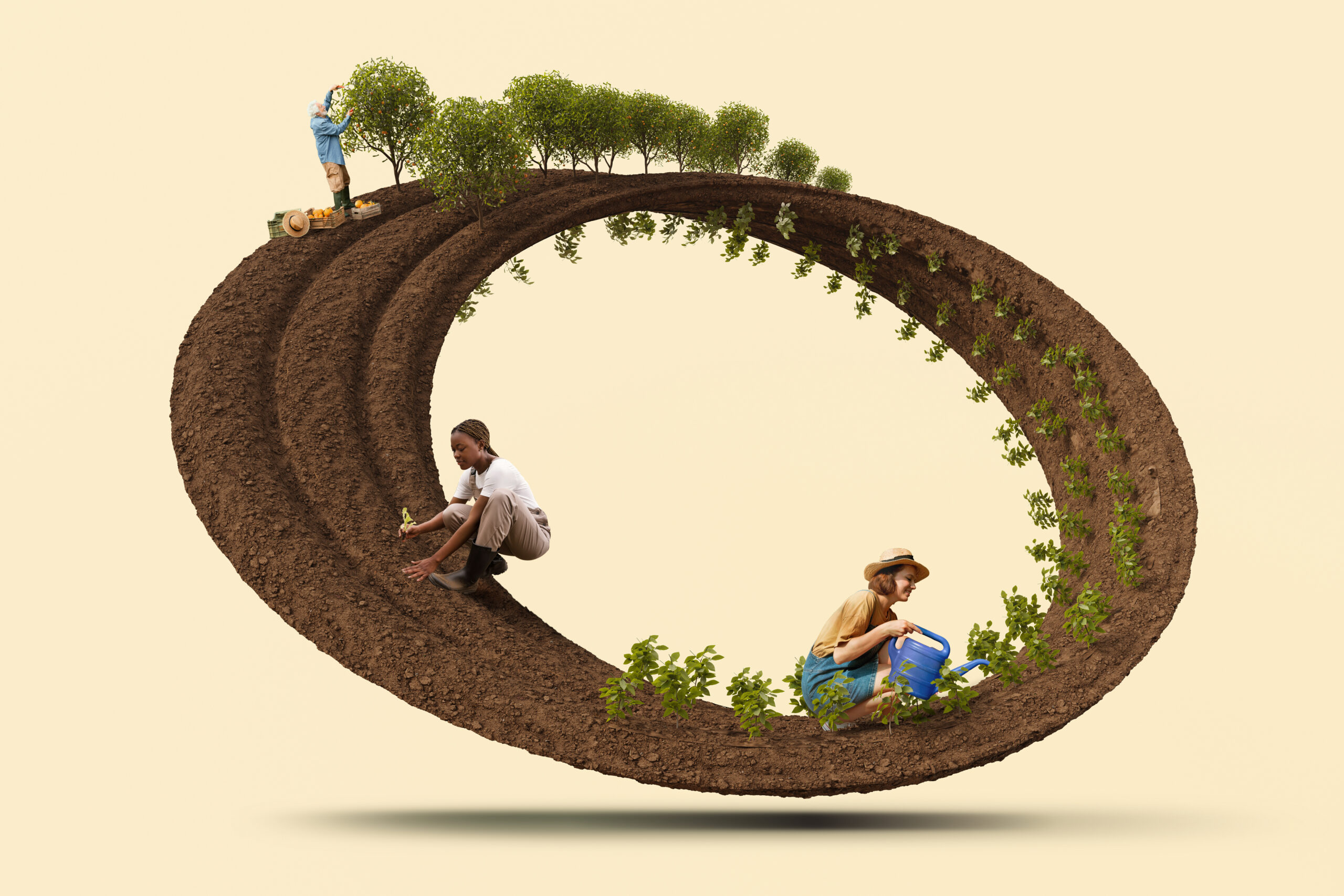
In agriculture, nothing is wasted if one knows how to make good use of it. Centuries of farming followed the linear approach, such as produce, consume, and discard. Additional side effects are that natural resources are being drained. A different approach now rewrites this story, namely, the circular farming systems.
These systems represent the circular economy applied to agriculture, whereby waste becomes a resource and every input is recovered or regenerated. Attention here is not focused on producing more, but also on producing better.
What Are Circular Farming Systems?
In a nutshell, circular farming systems mimic the balance of nature. Nothing ever goes to waste in a natural ecosystem, as fallen leaves feed the soil, nourishing the organic matter that feeds new growth. A circular farming system does much of the same, adding value to agricultural by-products for their potential to be made into valuable inputs.
These valuable materials are cycled back into the farming process, rather than being allowed to build up or pollute. Examples include:
- Composting or biogas fuel out of the wastes of livestock.
- Crop residues are transformed into mulch or organic fertilizer.
- Food would be recycled either through animal feeding or decomposition back to the soil.
It creates closed loops of materials and products, decreasing the consumption of synthetic fertilizers in agriculture, which improves soil quality and lessens the carbon footprint from farms.
Why Transition Towards a Circular Economy in Agriculture?
Traditional farming relies on a take, make, dispose model. Means this type of farming takes from nature, grows crops, sells the produce, and then discards the rest. That may work in the very short run, but it weakens both the environment and the economy eventually.
About one-third of all food produced, an estimated 1.3 billion tonnes, is lost or wasted, accounting for roughly 10 percent of the total global greenhouse gas emissions, according to the FAO.
The circular economy of agriculture transforms such losses into opportunity, as treating waste as a resource allows farms to cut input costs and generate renewable energy, naturally enhancing soil health in the process-all in a manner that makes farms more resilient to climate change and less dependent on external inputs, thus helping farmers secure productivity and profitability.
How do Circular Farming Systems Work?
It is a form of farming that connects all the processes together into one regenerative loop. Circularity comes from an approach to resources, namely: collect, transform, reuse, and regenerate.
- Resource Collection: Organic wastes that generally include manure, crop residues, and food scraps are collected.
- Transformation: These wastes are composted, fermented, or otherwise treated into fertilizer, feed, or biogas.
- Reuse: Farm products are reused to condition the soil, for animal feed, or as fuel in machinery.
- Regeneration: The production cycle is renewed in such a form as to create a system producing little, if any, waste.
This means a dairy farm can turn the biogas into electricity, make use of the slurry for fertilizing purposes, and grow its own fodder that the cattle will need. This is the self-sustaining loop that so efficiently contributes to a circular economy in agriculture.
How Does Waste Become a Resource in Circular Economy in Agriculture?
Agricultural waste can either pollute the environment or power sustainability, whereas in circular farming systems, it is viewed as an asset.
Therefore, crop residues can be converted into biochar and help improve soil carbon and water retention.
- Animal Manure to Biogas and Organic Fertilizer: One cow can excrete around 85 cubic feet of biogas each day. Using that manure through a biogas unit will result in electricity to power one home for the day.
- Food Waste to Animal Feed and Soil Conditioner: Food wastes and leftover materials from processing can be made into nutritious feeds or compost.
- Wastewater to Irrigation: Treated farm wastewater can be reutilized safely for crop growth.
Principles of waste-avoiding methodologies, value creation at each step, and striving toward ecological balance enable circular farming systems. Indeed, Invade Agro stands for just this principle when it designs models that give back rather than take from the land.
What Role Does Technology Play in Circular Farming Systems?
Technology cements the building blocks of agriculture in a circular economy with smart tools that are data-driven in nature, keep farmers in tune, cut down on inputs and wastes, and thereby make better decisions.
- Drones and soil sensors monitor crop health and irrigation needs.
- AI-based models provide nutrient cycle calculations and suggest optimal reuse options.
- IoT-based composting units are able to maintain adequate moisture and temperature for quick decomposition.
Precision irrigation systems can cut water waste by up to 50% compared to traditional methods, according to one report. Besides, combining traditional farming wisdom with innovation for circular farming systems renders them measurable, scalable, and very profitable.
What are the benefits of a circular economy in agriculture?
The circular economy brings added value to agriculture, while the impacts of the circular economy in agriculture go beyond the farm itself. Foreseen impacts will be economic, environmental, and social.
- Economic benefits: Farmers save as a result of a reduced application of chemical fertilizers and other external inputs. The by-products from wastes become sources of new revenue: compost, feed, or bio-energy.
- Environmental benefits: These circular systems minimize methane and carbon emissions, adding fertility to the soils. Crop-livestock integration and recycling of resources ensure that biodiversity is conserved during the restoration of soil life.
- Social benefits: This will encourage local entrepreneurship, skill development, and increased employment in rural areas and will help the farmers evolve as innovators and problem-solvers.
In general, circular farming systems come up with strong, more sustainable communities that will build resilient food systems over time.
What Challenges Affect Circular Farming Systems?
There are numerous types of barriers standing in the way of such a promising agricultural circular economy.
- Lack of awareness: Most smallholders do not know how to get started or scale up their circular models.
- Initial investment: All the biogas units, composting plants, and treatment systems need financing.
- Policy Incentives: Those are government incentives that are in development, plus carbon credits and training.
Of course, these are all transitional challenges. Every year, awareness campaigns, collaboration with the private sector, and innovative financing make embracing a circular farming system easier for farmers.
How Can Farmers Build a Future with Circular Farming Systems?
In the future, farming needs to increasingly be based on our ability to regenerate what we use, which is what a circular farming system can do for the farmer.
This can be initiated by every farmer through composting of waste, recycling water, and reintegration of livestock and crops. Each one of these practices will create a chain reaction leading to a self-perpetuating ecosystem with optimized efficiency, but, at the same time, with minimum damage to natural resources.
Invade Agro Global leads this change in helping farmers with research, technology, and models for sustainable farming in tune with the circular economy in agriculture. In other words, as the mission says, everything should have a purpose, and each harvest should bring balance back to earth.
Overall…
Circular farming is not a trend that will pass with time; it is farming being created. It has come to consider waste as an opportunity and to grow in harmony with the planet.
We should not aim at the exploitation of more land since the need for food keeps rising, but rather make better use of what we already have. Once we close the loop and accept the notion of regeneration, farming becomes much more than a profession: it is a promise toward the future.
With circular farming systems, sustainability and productivity no longer stand apart but are aligned to work toward one key goal: a world wherein farming feeds the planet, not just people.